Thursday, February 28, 2002
1888 organ plays sweetly again
Restoration takes man 1,000 hours
By John Davis
Poughkeepsie Journal
Reprinted by permission
 |
Lee Ferris/Poughkeepsie Journal
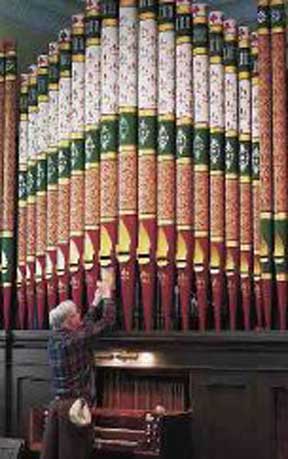
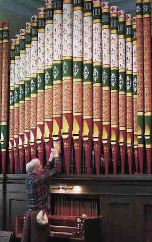
Kenneth Stark, a member of the Hyde Park Reformed Church congregation, works Wednesday on one of the stenciled designs painted on the pipe on the 1888 Odell Tracker organ. The organ, which has 713 pipes, took Stark more than 100 hours to paint. The entire restoration took more than 1,000 hours. |
 |
Lee
Ferris/Poughkeepsie Journal
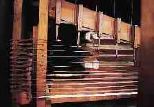
The mechanical assembly of the 1888 Odell organ uses wooden trackers to activate sound from the pipes. Each tracker connects a key to a pipe. |
Broken for decades and once thought too costly to repair, the pipe organ inside the Hyde Park Reformed Dutch Church has been resurrected through the volunteer efforts of one of the faithful.
For the first time in nearly 33 years, the organ filled the church with glorious sound last Sunday.
The tones swelling from the 713 pipes were quite a difference to that produced by the electric organ and speakers the church has used since 1970.
''The first time you hear them, it's awesome,'' said parishioner Ed Robison, throwing up his hands toward the lofty ceiling of the church built in 1824. ''It just fills the whole auditorium up.''
Kenneth Stark, a retired medical technician, spent about 1,000 hours during the last three years overhauling the organ and pipes. His volunteer efforts made Sunday's resurrection of the Odell pipe organ possible, since the estimated $50,000 cost of a professional renovation was cost-prohibitive for the church of 160 parishioners.
''He took a pile of junk and restored it,'' the church's pastor, the Rev. Tom Fiet, said. ''It's really a perfect manifestation of the Gospel: It's taking what has died, and turned to rubble, and bringing it back to life.''
Stark, who likes fixing and building things, said he could not stand to sit in church on Sundays and see the pipe organ, which was donated in 1888, sit there dormant.
''I've always been able to repair anything,'' he said. ''I couldn't believe they had this beautiful organ sitting there and not using it.''
Trackers eat up time
Stark said figuring out the mechanical operation of the pipe organ was not difficult. What was time consuming was rebuilding hundreds of wooden ''trackers'' connecting the console's keys and myriad pipes.
''The organ itself is a very simple instrument -- there's just a lot of it,'' Stark said.
Not only the sound but the appearance of the organ pipes have been restored and enhanced by painted stencils of floral patterns. Stark cut out the stencils to match traces of the original patterns on the pipes, which he did not discover until layers of gold paint were stripped from the pipes.
''What happened is the lead from the paint fused with the zinc from the pipes and left a ghost of the stencil,'' Stark said.
Just the visual transformation of the pipes -- from a dull gold to colorful patterns of flowers and clovers -- moved one parishioner to tears Saturday night.
''She just started crying; it was so beautiful,'' Robison said.
As the man responsible for the organ restoration put the finishing touches on a stencil Wednesday afternoon, he stepped back a second to admire his work and say how glad he is to have the pipe organ no longer sitting dormant on Sundays.
''It did come out nice,'' Stark said. ''It's nice to have the stencil work, but it's better to have it up and running.''